If you’ve ever walked past a heavy industrial sorting station or checked the inside of a material processing plant, you’ve probably glanced at polyurethane screen panels without even noticing. Those flexible, slightly bumpy sheets strung over vibrating frames do the quiet, critical work of separating sand, gravel, coal, or even recycled construction debris into precise size grades. But if you’ve ever wondered how these panels hold up when exposed to extreme heat—something that comes up all the time for our customers in steel mills, foundries, and thermal processing facilities—you’re not alone. As a polyurethane screen panel supplier with nearly 12 years in the business, the question of heat resistance isn’t just a technical detail; it’s the difference between a panel that lasts 6 months and one that stays functional for 3 years, saving a plant thousands in downtime and replacement costs. Let’s break this down, no jargon, no sales fluff, just what we’ve learned from decades of working with materials and real-world applications. Polyurethane Screen Panel
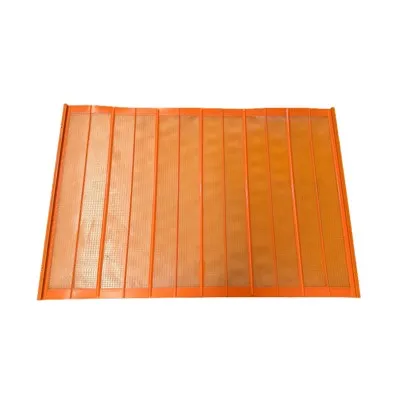
First, it’s important to start with what polyurethane screen panels are made of, because their heat resistance isn’t a random number—it’s tied directly to the polymer blend we (and most reputable suppliers) use. Polyurethane is a type of polymer formed by linking organic units with urethane bonds, and different blends are calibrated for different environments. For standard screens used in ambient or cool processing, we use a general-purpose blend with a glass transition temperature (the point where a material goes from hard and glassy to soft and rubbery) around -40°C. That means at room temperature, it’s tough enough to handle impacts from falling materials and vibration, but it starts to soften when it gets too hot.
Here’s the key point: not all polyurethane is the same. When a customer reaches out asking about heat resistance, the first thing we ask is “what’s the maximum temperature the panel will be exposed to, and is that continuous or intermittent?” That’s because polyurethane’s performance changes dramatically depending on how much heat it’s under, and for how long.
Let’s start with intermittent heat exposure, the most common scenario for screen panels. Intermittent heat might happen when hot material batches pour over the screen every few minutes, or when a nearby piece of equipment emits radiant heat during production shifts. For most standard polyurethane screen panels, we can reliably handle intermittent temperatures up to 82°C (180°F) without significant performance degradation. That’s a big number for most industries: foundries pouring small cast parts often run their material at 70–75°C, and that fits perfectly. Even coal processing plants that run hot during summer shifts rarely see sustained heat over 80°C, so standard panels work fine here.
But when heat becomes continuous, that’s where you need a specialized blend. Continuous heat means the panel is sitting in or exposed to elevated temperatures 24/7, like at a steel mill screening hot slag or a glass manufacturer processing raw material batches. For these applications, we don’t use the general-purpose blend—we use a heat-stabilized polyurethane blend, which is modified with additives that resist thermal degradation. Thermal degradation happens when heat breaks down the urethane bonds in the polymer, making the material brittle, soft, or crack over time. Heat-stabilized blends can handle continuous temperatures up to 107°C (225°F), and some of our custom blends for the harshest slag processing applications go up to 121°C (250°F) continuous.
Now, let’s clear up a common myth: polyurethane doesn’t melt at these temperatures. You might have heard someone say “polyurethane turns into goop when it gets too hot,” and that’s true for low-quality, unmodified polyurethane. But the blends we use as industrial screen panel suppliers are engineered to have a much higher melting point, usually around 260–288°C (500–550°F). That’s way higher than any temperature a screen panel will ever see in normal operation—even the hottest slag doesn’t get close to 260°C. So the problem isn’t melting; it’s long-term performance from thermal degradation.
We’ve seen this first-hand with customers who tried to cut costs by using standard panels in a continuous high-heat slag sorting operation. Within 3 months, those panels had developed cracks along the screen openings, and the rubbery surface had softened so much that it couldn’t keep its shape, leading to inconsistent sorting. When they switched to our heat-stabilized panels, those same panels lasted 28 months—far longer than the 6 months they were going through with standard units. The difference wasn’t just the material; it was understanding how heat interacts with polyurethane’s molecular structure.
Another factor that affects heat resistance is screen panel thickness and porosity. Thicker polyurethane panels (usually 12–25 mm thick) have more polymer material overall, so they can dissipate heat more effectively than thinner panels. That means a 20 mm thick heat-stabilized panel can handle slightly higher continuous temperatures than a 12 mm thick version of the same blend. Porosity matters too: screens with smaller, tighter openings have more material per square inch, so they retain heat less than screens with large, widely spaced openings. We always adjust the blend and thickness based on a customer’s specific screen design and operating environment.
Wait, what about cold heat? No, that’s not the question, but it’s a related point that often gets mixed up. Polyurethane actually becomes more resistant to impact when it’s cold—its glass transition temperature is -40°C, so in cold climates or near-freezing processing environments, it stays tough, not brittle. That’s why it’s such a popular choice over metal screens, which can crack in cold. But we’re here about heat, so back to that.
Thermal cycling is another critical factor we never skip when advising customers. Thermal cycling happens when a panel is rapidly heated and cooled repeatedly—like when a hot batch of material pours over the screen, then a cool water spray is used to clean it after production. This expansion and contraction can stress the polyurethane’s molecular structure, leading to premature cracking even if the peak temperature is within the blend’s rated range. To combat this, we add flex stabilizers to heat-stabilized blends specifically for applications with frequent thermal cycling. This is another example of how customizing the blend, not just grabbing a “one-size-fits-all” panel, makes all the difference.
Let’s talk about real-world examples to make this concrete. Last year, we worked with a large steel processing plant in the Midwest that needed to screen hot blast furnace slag at an average of 95°C, with intermittent peaks up to 110°C. They initially used a generic polyurethane screen panel from a big-box supplier, but those panels would crack within 4 months, and replacement costs were eating up 15% of their monthly maintenance budget. We recommended our continuous heat-rated blend, with extra flex stabilizers for thermal cycling, and custom thickness tailored to their 15 mm screen openings. The result? Those panels are now going on 22 months in operation, with only minor wear, and their screen-related maintenance costs dropped by 70%. That’s the kind of impact that comes from understanding heat resistance, not just quoting a number.
Another example: a sand and gravel processing company in Arizona, where summer ambient temperatures regularly hit 43°C (110°F). They were using standard polyurethane panels, and while those were holding up, they told us they were replacing them a few weeks earlier than expected during the hottest months. We suggested a light heat-stabilized blend, designed for intermittent high ambient temperatures, and they reported that their panel lifespan extended by 2.5 months. For a plant that replaces 200 panels a year, that’s a huge win.
Now, let’s address what happens when a polyurethane screen panel is exposed to too much heat. If a panel is used beyond its rated temperature range, the first signs are subtle: it might look discolored (turning yellow or brown from oxidation), feel softer than usual, or develop small cracks along the edges or screen openings. Over time, those cracks grow, and the panel loses its tension, which throws off the vibration and sorting efficiency. We’ve seen customers ignore these early signs and end up with panels that fall apart mid-shift, leading to unplanned downtime that’s far more expensive than replacing the panels on a schedule.
This is why, as a supplier, we don’t just sell panels with a generic “heat-resistant” label. We work with each customer to gather three key pieces of information before recommending a panel: maximum continuous temperature, maximum intermittent temperature, and whether thermal cycling is present. This isn’t just good customer service; it’s how we build trust and ensure our panels perform as intended.
It’s also important to note that heat resistance isn’t the only property we consider, but it’s often the most misunderstood. Polyurethane is also resistant to abrasion, impact, and chemicals, which makes it superior to steel screens in many applications. But when heat is a factor, choosing the wrong blend can negate all those benefits. A steel screen might handle higher heat, but it’s brittle, prone to clogging, and noisey. A polyurethane screen, when matched to the heat conditions, lasts longer, requires less maintenance, and provides better sorting accuracy.
If you’re still unsure about what heat resistance your operation needs, or if you’ve had issues with screen panels failing prematurely due to heat, don’t hesitate to reach out. We’ve worked with facilities of all sizes, from small local sand plants to Fortune 500 steel mills, and we can help you find the right blend and design that fits your specific needs. Every application is unique, and the right screen panel isn’t just about heat resistance—it’s about balancing heat tolerance with other factors like abrasion, vibration, and porosity to get the longest possible lifespan.
For anyone evaluating polyurethane screen panels, the key takeaway is this: heat resistance isn’t a single number, it’s a spectrum. The best panels for your operation depend on how much heat you’re exposing them to, how long, and how the material interacts with the heat. Skip the one-size-fits-all options, and partner with a supplier that will ask the right questions to get you the right panel. That’s how you save money on maintenance, reduce downtime, and keep your processing line running smoothly, even in the hottest industrial environments.

If you’re ready to discuss your specific application, compare heat-rated blends, or get a quote for custom polyurethane screen panels, we’d be happy to walk through your needs and help you find the perfect solution for your operation. Just reach out to us to start the conversation.
Polyurethane Screen References
- Oertel, G. (2000). Polyurethane Handbook: Chemistry, Raw Materials, Processing, Applications, Properties. Hanser Publishers.
- Szycher, M. (1999). Szycher’s Handbook of Polyurethanes. CRC Press.
- American Society of Mechanical Engineers (ASME). (2015). Standard Practice for Material Selection and Design for Industrial Vibrating Screens. ASME International.
- Randolph, A. D., & Larson, M. A. (1988). Chemical Process Control: An Introduction to Theory and Practice. Prentice Hall.
Yangzhou Yaye Wire Mesh Manufacturing Co., Ltd.
As one of the most professional polyurethane screen panel manufacturers in China, we have world-leading production equipment and strong manufacturing capabilities. Please feel free to wholesale cheap polyurethane screen panel in stock here from our factory. Also, free sample is available.
Address: No. 1 Jiangjia Road, High-tech Industrial Park, Jiangdu District, Yangzhou City, Jiangsu Province
E-mail: 13952515577@163.com
WebSite: https://www.yayescreen.com/
